
 About
About 


Dynamite's July 2024 solicits see the launch of Powerpuff Girls #1 and Thundercats: Cheetara #1, as well as Red Sonja Adventures Omnibus.
Posted in: Look! It Moves! by Adi Tantimedh, Recent Updates | Tagged:
Look! It Moves!#6 By Adi Tantimedh – The Loneliness Of The Long-Distance Blind Swordsman
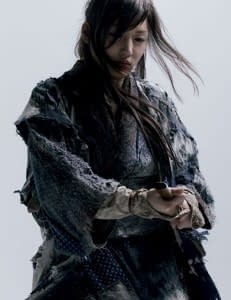
It's always fun to write about ZATOICHI, and the upcoming DVD release of the latest version of the franchise, ICHI, gives me a good excuse.
Every country has a favourite rebel hero in pop culture, a character who's not part of the status quo but on the side of the angels. Britain has Doctor Who. Japan has Zatoichi. Originally created by novelist Kon Shimozawa, ZATOICHI is a blind wandering gambler and masseuse in medieval Japan. In a time where a rigid caste system is in place, being blind places him right at the bottom of society. He was often spat on, mistreated, insulted wherever he went, all of which he shrugs off with a stoical repose. He was a genius at gambling, because his hearing let him hear which side the dice landed on and he could tell if the yakuza running the gambling dens cheated with fixed dice. And when they tried to kill him to get their money back, he would pull his sword from his cane and leave a pile of eviscerated yakuza leaking on the street. Zatoichi was both underdog and deadly avenger at the same time. He sided with exploited peasants and the underclass, sympathized with fallen women, befriended prostitutes and defended kids. He always ended up slaughtering the bad guys in an epic showdown of swords and blood, then quietly leave town afterwards. He's a kind of superhero, a killer of bullies. Charlie Chaplin with a sword.
 The first movie was released in 1962 when the Samurai, or Chambara, movie was at its peak. ZATOICHI was the most successful of many chambara series in that era, with an average of two, sometimes three sequels released a year, and a steady run of 25 movies were made by the early 1970s. I don't have room to list all of them here. Zatoichi was played by Shintaro Katsu, whose stooped, slightly pudgy build and puffy face put on an act of a shambling teddy bear, but could suddenly display lightning-fast reflexes when he drew his sword.
Katsu came from a traditional Japanese theatrical family and transitioned into movies. He was versed in acting, singing, comedy, acrobatics and martial arts. The success of the Zatoichi movies made him a star and gave him an enormous amount of power in the film industry. He formed a production company, Katsu Productions, and took over not only the ownership and production of the Zatoichi franchise, and also produced the movie versions of other chambara manga like Kazuo Koike's LADY SNOWBLOOD and LONE WOLF AND CUB, the latter starring his brother Tomisaburo Wakayama (who, like Katsu, will have starred in over 100 movies before he died). When the 25th Zatoichi movie was completed and television began to overtake film production, Katsu moved the character to television, using the same standing sets and shooting the episodes on 16MM film. He often employed name directors and even wrote and directed several episodes himself. Over 100 episodes were made before the series ended in the late Seventies.
 Katsu had a reputation as a wild man, hard-driving, hard-gambling, hard-loving, hard-doping, and when he got busted for possession, his career began a downward spiral, since that carried a greater social stigma in Japan than in the West. He produced and directed one last ZATOICHI movie in 1989, featuring an older, more melancholy Zatoichi, but production was marred by the death of a stuntman at the hands of Katsu's son in a sword fight scene that went horribly wrong. Katsu never played Zatoichi again, and his career and health steadily declined until his death from cancer in 1997.
Zatoichi was in hiatus throughout the 1990s, with people remembering the character fondly through reruns and videotapes. Interestingly, there was never a comic book series, though the character is frequently spoofed and homaged in other comics, anime, movies and video games, even to this day. The character has his share of fans in the West. Quentin Tarantino is one of them, and there was a rumour that he wanted to remake one of the Sixties entries, ZATOICHI'S PILGRIMMAGE, and Miramax bought the rights, which is why that particular title is not available on video or DVD in the West. Zatoichi was an influence on Frank Miller's run on DAREDEVIL in the 80s. The Rutger Hauer blind swordsman movie BLIND FURY from 1989 was obviously inspired by Zatoichi, down to the plot about helping a little boy find his father and then save them from gangsters.
In the early 2000s, Takeshi Miike desperately wanted to make a straight Zatoichi movie. The story he wanted to tell was the grand finale of the saga of Zatoichi, but the rights owners did not want to bring back the character just to finish him off, they wanted a profitable revival. Ironically, the actor Miike wanted to cast, "Beat" Takeshi Kitano, got the nod from the owners and ended up writing, starring in and directing a spanking new ZATOICHI movie in 2003.
Kitano was never a fan. He thought Zatoichi's genius at gambling and swordplay were patently ridiculous and used to mercilessly spoof him in comedy skits, slicing up the wrong people, stepping off the wrong end of boats and drowning and so on. When he came to direct his version of the franchise, he said he didn't see Zatoichi as a good guy but a monster, comparing him to an atom bomb that drops into a town, wipes out the bad guys and then leaves everyone else to clean up the mess. His Zatoichi was stripped down, exuding none of the rambunctious, roly-poly humour of Shintaro's portrayal. Kitano's Ichi was a minimal, sly slab of silent menace that suddenly turned lethal to anyone that drew on him.
Kitano's reboot was a hit domestically and internationally, and fans have wanted him to make more. However, Kitano is the busiest man in show business in Japan – he writes magazine and newspaper columns, hosts game shows and talk shows, appears in print and TV advertisements, to the point of appearing on TV in Japan every night of the week, and acts in other people's TV series and movies. And then he also produces, writes, directs, edits and stars in his own highly personal and quirky movies, even jokingly referring to his last three as his "artistic suicide trilogy". He has said, half in jest, that he's keeping another ZATOICHI movie in his back pocket in case all his own movies bomb and he needs another box office hit. In short, Kitano is in a position where he can do whatever the hell he wants, but the trick is finding the time for him to do it.
While fans were waiting for the next movie, Takeshi Miike finally partly realized his dream by directing a critically acclaimed three-hour stage version of ZATOICHI starring Sho Aikawa in 2007. Miike brought a combination of traditional stage craft and avant-garde design to lend the production a multilayered, postmodern feel. In 2004, Kitano repaid his social debt to Miike for bringing him to the ZATOICHI producers' attention by appearing in Miike's Godardian samurai movie IZO. Crazed and non-linear, IZO was a deconstruction of masculine destructive urges and its place on the Buddhist path. The title character, Izo Okada, was a real-life disgraced samurai assassin who had previously been played in the 1969 movie HITOKIRI by… Shintaro Katsu. Everything seemed to revolve around and come back to Zatoichi and Katsu.
Since Kitano wasn't going to make another entry in the series anytime soon, the producers hired young director Fumihiko Sori to make a different kind of reboot in 2008. This time, the blind swordsman would be a young woman. ICHI (not Miike's ICHI THE KILLER) is a kind of sequel to the original franchise. Idol and former bikini model Haruka Ayase plays the wandering musician who was cast out because she was raped, so she's emotionally closed off and wary. She wanders the land in search of the blind swordsman who used to visit her regularly when she was a child and taught her swordsmanship, who may be her real father, which is what she wants to find out. The usual Zatoichi conventions are there: she uses her hearing to win at gambling, she cuts down scores of enemies, she befriends a little boy who helps her. The difference is she has an incompetent samurai who falls in love with her, and who opens her heart again. The basic story has been reconfigured to accommodate a young female lead, including giving her a love story. It looks like the intended audience for ICHI is a younger, teenage, female, dating audience. Compared to all the other movies, ICHI is more somber and earnest, with almost none of the humour that Katsu and Kitano brought to their takes, since that might have spoiled the tragic romance at its centre. Ayase's Ichi is depressed, subdued, closed down compared to Katsu's ribald love for life or Kitano's air of dangerous mischief. ICHI is as slick and accomplished a movie as you can expect, but its script made me wish the heroine was as self-reliant as the hero was in the original series, since he never needed anyone to redeem him or help him with the baddies. But what ICHI demonstrates is the flexibility of the format and the franchise, and it doesn't exclude the possibility of more ZATOICHI or ICHI entries in the future.
When you catch the ZATOICHI bug, you always look forward to a new one.
And hope it's good.
Kind of like with DOCTOR WHO, really.
25 of the original ZATOICHI movies and Kitano's 2003 version have been released on DVD in the US. The latter eight and Kitano's are available in the UK. The first 26 episodes of the TV series are on DVD in the US. ICHI wil be released on DVD in the UK in August and in the US in 2010.
Classic Katsu:
Katsu's last with cheesy 80's ballad:
Kitano:
Takashi Miike's stage version:
Ichi:
Slicing and dicing at lookitmoves@gmail.com
© copyright Adisakdi Tantimedh
Enjoyed this? Please share on social media!



Stay up-to-date and support the site by following Bleeding Cool on Google News today!